
How to Calculate Calories and Get Your Cat to Lose Weight!
Let's talk about healthy, safe ways to help your cat lose weight and how to track their progress. Whether you’ve got a fluffy couch potato or an active little jumper, weight management is essential for your cat’s health and longevity.
Check out the video version on YouTube!
How Much Should You Feed Your Cat?
Measuring their weight alone isn’t enough.
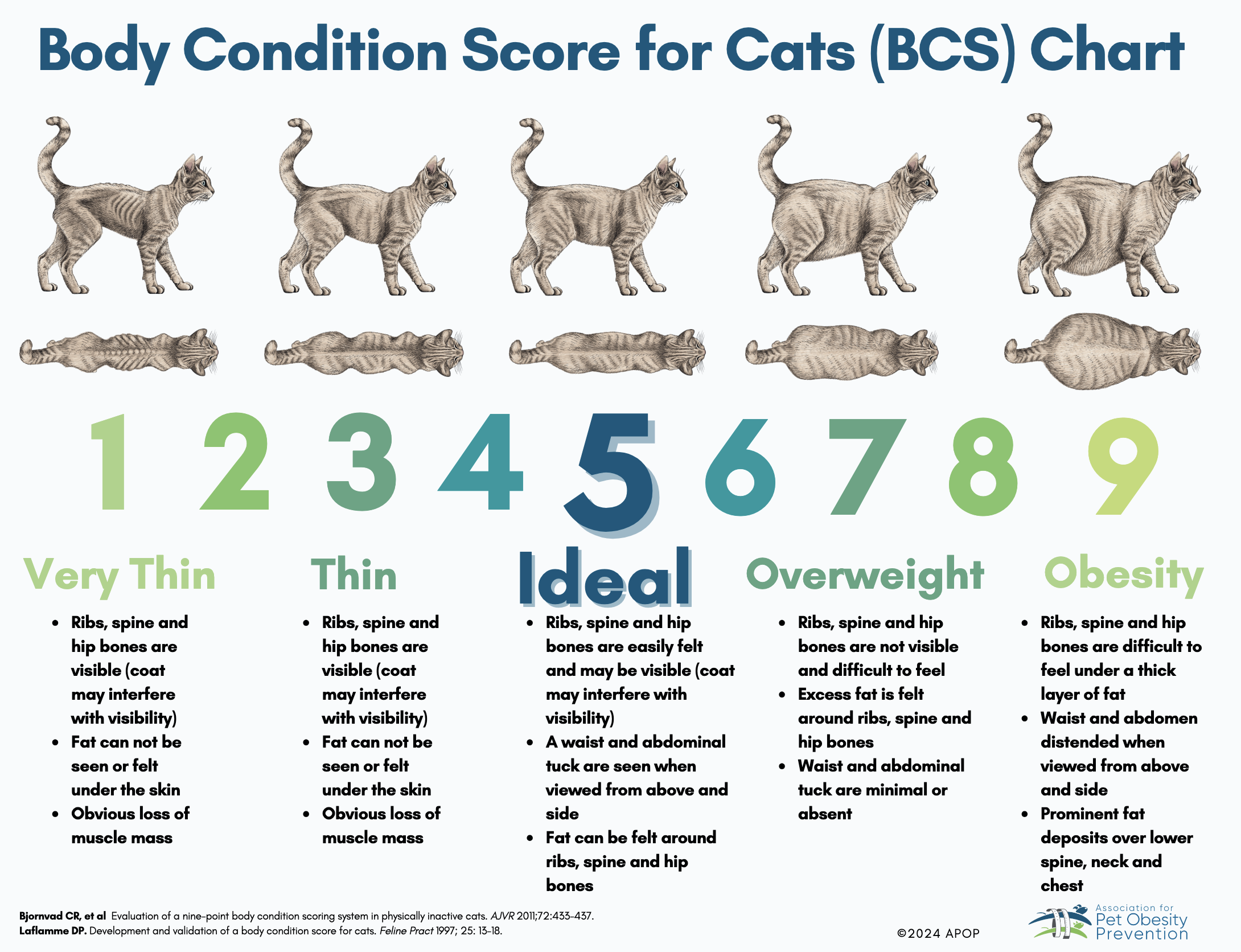
Not every cat is meant to weigh 10 pounds. A 10-pound Maine Coon could be underweight, while a 10-pound Munchkin might be obese. That’s why veterinarians often use Body Condition Score (BCS) instead of just the scale.
BCS works a lot like BMI in humans, factoring in your cat’s body size.
The 9-point BCS scale is common in veterinary medicine:
- 5 out of 9 is ideal.
- Lower numbers mean underweight, higher numbers mean overweight.
How to Check Your Cat’s BCS
Because fur can hide a lot, you’ll need to feel your cat — not just look. Here’s what to check for a 5/9:
- Slight waist behind the ribs.
- Ribs are palpable with a light fat covering.
- Minimal abdominal fat pad (primordial pouch doesn’t count).
Pro tip: Stretch out your hand and feel the pad below your fingers. Your cat’s ribs should feel similar at the right weight.
If you’re unsure about your cat’s BCS, ask your vet. They assess it during every exam, even if they don’t always mention the number.
Calculating Your Cat’s Calorie Needs
Every cat’s metabolism is different, so calorie counts are a starting point. Safe weight loss is 0.5–1% of body weight per week.
Step 1: Find Resting Energy Requirement (RER)
Formula:
RER = 70 × (body weight in kg)^0.75
Convert pounds to kilograms by dividing by 2.2.
Example for a 10-lb cat:
10lbs ÷ 2.2 = 4.54 kg
RER = 70 × (4.54)^0.75 ≈ 217 kcal/day
Step 2: Adjust for Life Stage & Goal
Multiply RER by the right factor:
- Neutered adult: × 1.2
- Intact adult: × 1.4
- Inactive/obese-prone: × 1.0
- Weight loss: × 0.8
- Weight gain: × 1.8
- Kittens: × 2–2.5
Warning: Never cut calories by more than 15–20% per month without veterinary supervision. Too-fast weight loss can cause fatty liver disease, which is life-threatening.
Step 3: Calculate how much food to offer your cat based on the calculated calories
The Cat Repairwoman team built a cat food calculator based on what I use at the clinic every day to answer this common question. Click the link below to access the calculator, or read the guide on how to use the cat feeding calculator.


Cat Food Calculator - How Much to Feed Your Cat!
To calculate the amount of food to feed I recommend starting with deciding how much wet you want to feed. Wet is generally preferred as it helps cat feel full and keeps them better hydrated.
For example let's use Petey from my YouTube video (he will not eat more than 1/4 can of wet per day so we are working with his preferences):
One can of Petey’s food is 120 calories per can so to calculate the calories in 1/4 can is 0.25 x 120 = 30 calories.
We want to start with his calculated 260 calories total per day so we subtract the wet from the total calories.
260 total - 30 wet = 230 calories in dry.
Petey’s dry food is 360 calories per cup so to calculate the amount to feed in dry 230 calories divided by 360 calories in a cup = 0.64 cups or just under 2/3 cup dry per day.
Tips for Feeding in Multi-Cat Homes
- Use covered Microchip/RFID feeders (like SureFeed) for individualized meals
- Meal feeding: Measured portions for 20–30 minutes, 3× daily that are monitored
- DIY feeding stations: Cut entry holes in totes sized for smaller cats only
- Family coordination: Daily portion containers, feeding logs, or a “designated feeder” to prevent overfeeding
Exercise & Enrichment
Aim for 15 minutes of play, 3 × daily.
Some ideas:
- Food puzzles or treat balls
- Scatter dry food for them to “hunt”
- Move food to a different room
- Wand toys, even if your cat just bats lazily at them
Remember: Any movement burns calories, even slow, gentle play.

Click for all posts tagged with Enrichment
Tracking Progress
- Weigh your cat weekly
- Aim for ~1% body weight loss per week
- Use a body condition chart for visual reference
- Adjust calories gradually if progress stalls
Final Thoughts
Helping a cat lose weight isn’t quick or easy but it’s a steady, patient process. Work with your veterinarian, track progress closely, and celebrate small wins. Your cat will thank you with more energy, better health, and (hopefully) more years by your side.